
Surface Material Innovations for Indoor & Outdoor Arenas
Durability, Traction & UK Weather Performance
Equestrian arena surfaces play a critical role in horse welfare, rider safety and long-term facility performance. Whether for showjumping, schooling or racehorse conditioning, the right footing must balance cushioning, stability, and resilience - particularly in the UK, where rainfall, clay soils, and seasonal freeze-thaw cycles place heavy demands on arena design.
This overview breaks down the latest material innovations and the science behind modern arena footing.
What Makes a Good Arena Surface?
A high-quality surface must deliver three core performance factors:
Cushioning - absorbs impact to reduce strain on joints and soft tissues.
Traction - prevents slipping during take-off, landing and tight turns.
Stability - resists deep tracking and shear forces from repeated use.
Modern surfaces are engineered to achieve consistent performance across all seasons, with measurable properties such as shear strength, energy return, and moisture retention.
Innovations in Synthetic Footing
Synthetic surfaces have advanced significantly, especially for indoor arenas where dust control and year-round consistency are essential.
Waxed Sand Blends
Combine silica sand with wax coatings to stabilise particles.
Typical shear values of 0.6-0.8 (measured using biomechanical testers) provide reliable grip without becoming overly firm.
Wax helps maintain moisture balance, reducing dust and improving longevity.
Fibre-Enhanced Systems
Geotextile fibres mixed with sand create a surface that mimics turf.
Compression moduli of 100-150 kPa improve shock absorption and traction.
Often paired with rubber crumb layers to reduce concussion and noise.
These systems are popular for showjumping and dressage due to their predictable feel and reduced maintenance demands.
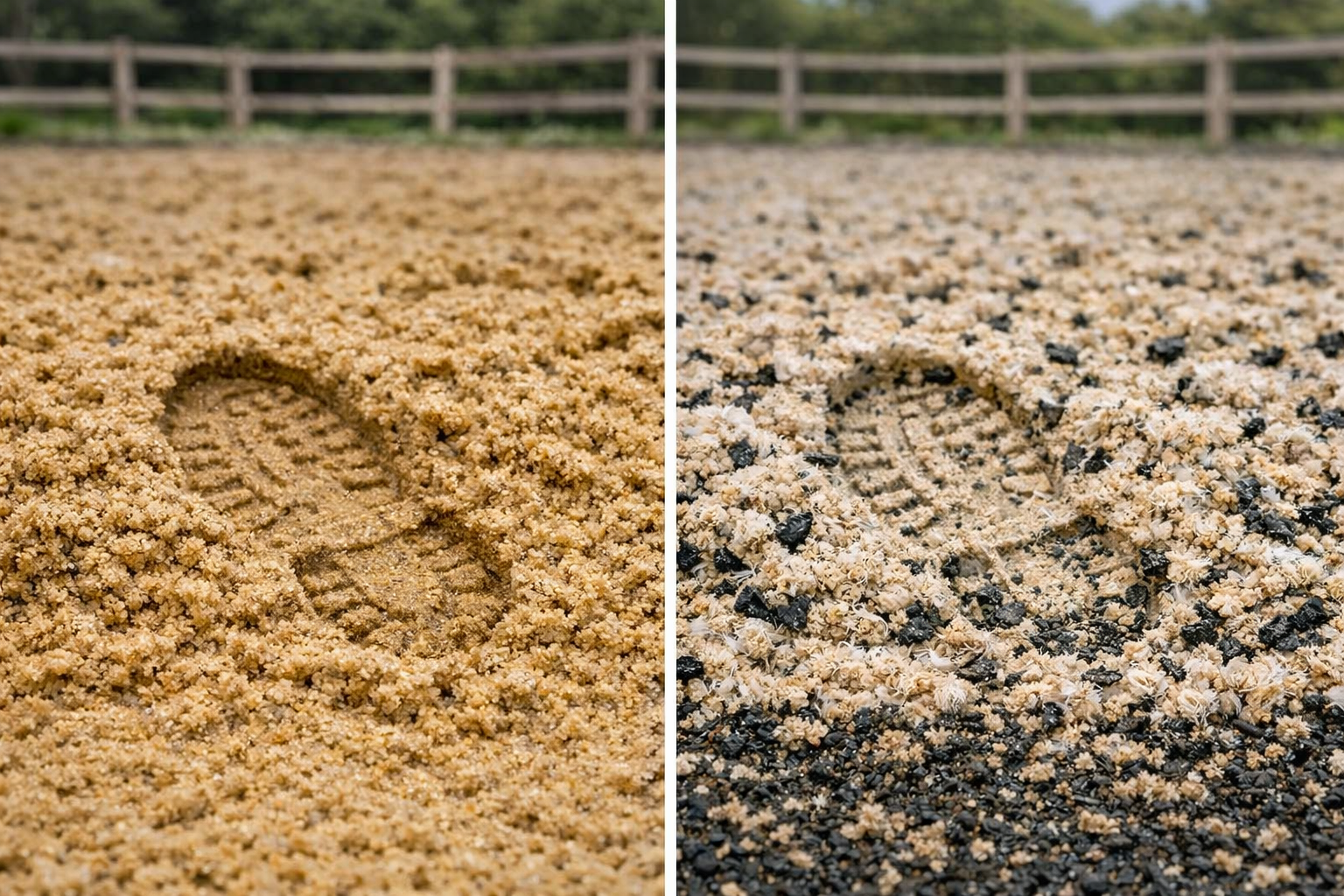
Left - Waxed Sand Blend
Right - Fibre Enhanced Surface
Outdoor Surfaces Built for UK Weather
Outdoor arenas must cope with heavy rainfall, clay soils and winter frost. Modern designs focus on permeability and structural stability.
Polymer-Bound Aggregates
Creates a free-draining, stable top layer.
Drainage rates of 300-500mm/hour prevent waterclogging even during prolonged rain.
Engineered Sub-Base Layers
Typically 150-200mm of compacted crushed stone.
Reinforced with geogrids to prevent movement and frost heave.
Designed to work with lateral and perimeter drainage systems.
These innovations ensure outdoor arenas remain rideable throughout the year, reducing maintenance and extending surface life.
Standards & Horse Welfare
Natural Surface Management
Sand surfaces with organic additives (e.g. wood fibre) rely on:
Moisture control via irrigation systems.
Tensiometers to monitor firmness.
Target penetration resistance below 2.5kN to avoid overly hard conditions.
Welfare & Regulatory Guidance
The Animal Welfare Act 2006 and DEFRA codes require surfaces that minimise the risk of injury.
BHS guidelines recommended minimum arena sizes (20m x 40m) and maintenance to prevent unevenness greater than 10mm.
Research from the Royal Veterinary College links poor surfaces to up to 30% of lameness cases, highlighting the importance of annual testing.
To conclude:
Advances in surface materials - from waxed sands to fibre-reinforced synthetics and weather-resilient systems - give UK equestrian designers powerful tools to create safe, durable, and high-performance arenas. By combining modern engineering with welfare-led standards, facilities can deliver consistent footing that supports horse biomechanics, withstands UK and enhances long-term usability.