
What is under an Arena Surface?
Drainage, Environmental Impact and Planning Conditions
A high-performance equestrian arena is built from the ground up. While riders often focus on the top surface, planners and engineers are far more interested in what lies beneath. The drainage system, sub-base, and environmental strategy are now central to whether a ménage, gallop, or training arena receives planning permission.
With local authorities placing increasing emphasis on flood risk, water quality, and sutainable land management, a well-designed drainage strategy is no longer a technical extra. It is a core planning requirement.
This post explains why drainage matters, what planners expect, and how a compliant system is designed.
Why Drainage Matters in Planning
Equestrian arenas create large areas of engineered, compacted ground that behave differently from natural soil. Without proper drainage, rainfall can:
Pool on the surface, making the arena unusable
Run off too quickly, increasing flood risk elsewhere
Carry sediment or contaminants into nearby water courses
Undermine the structural integrity of the arena over time
For these reasons, most planning approvals include pre-commencement condition requiring detailed drainage scheme. No works can begin until this is submitted and approved.
Sustainable Drainage Systems (SuDS) : The Modern Standard
UK planning policy strongly favours Sustainable Drainage Systems - approaches that mimic natural water movement rather than forcing water away through pipes.
For equestrian developments, SuDS can include:
Permeable Arena Surfaces - modern arena surfaces are designed to allow water to infiltrate through the top layer and into the engineered base below. This reduces runoff and improves year-round usability.
Filter Drains (French Drains) - stone-filled trenches containing perforated pipes that collect water from the arena base. These slow the flow, filter sediment, and direct water to a controlled discharge point.
Swales - shallow, grassed channels that temporarily hold and disperse water. Swales are particularly effective for managing runoff from roofs, yards and hardstanding.
Soakaways & Attenuation - where ground conditions allow, water can be stored underground and released slowly back into the soil. In clay areas, attenuation tanks or controlled discharge to a ditch may be required.
Why planners prefer SuDS?
The reduce flood risk, improve water quality, and demonstrate a responsible , future-proof approach to land management.
Environmental Impact & Water Quality Protection
For larger equestrian facilities - or those near streams, ditches or designated habitats - planners may require an Environmental Impact Assessment (EIA) or a targeted drainage and pollution-prevention report.
Key environmental consideration include:
Sediment control - runoff from an arena can carry fine particles that clog the watercourse and harm aquatic life. A well-designed drainage system filters sediment before discharge.
Nutrient & Contaminant Management - manure, bedding, and surface materials can introduce nutrients or pollutants. Drainage designs must show how these risks are prevented.
Hydrology & Groundwater - planners assess whether the arena will alter natural water flow, increase runoff, or affect groundwater recharge.
Biodiversity - swales, vegetated margins, and naturalised drainage features can enhance habitat value - a positive factor in planning decisions.
Technical Drainage Design: What Planners Expect to See
A drainage plan must be technical, measurable, and visually clear.
A compliant drainage design typically includes:
Cross-sections of the arena build-up, which show -
Top surface
Geotextile membranes
Clean angular stone layers
Perforated drainage pipes
Edge boards and retaining structures
Drainage Layout Plan, showing -
Pipe routes
Outfalls
Swales or soakaways
Levels and gradients
Connection points to existing ditches or watercourses
Hydraulic Calculations - planners often require evidence that the system can cope with rainfall events. This may include:
Runoff rates
Storage capacity
Infiltration test results
Flow control measures
Discharge Strategy - clear explanation of where water goes and how flood risk is avoided. This must comply with the drainage hierarchy:
Infiltration (soakaway)
Watercourse
Surface water sewer
Combined sewer (last report)
Maintenance Plan - a simple schedule showing how drains, membranes, and swales will be inspected and maintained over time.
Why a Strong Drainage Strategy Improves Planning Outcomes
A well-documented drainage design demonstrates:
Environmental responsibility
Compliance with natural SuDS policy
Protection of neighbouring land
Long-term usability of the arena
Reduced risk of enforcement or conditions breaches
Planners increasingly expect applicants to show not just what they are building, but how it will behave in the landscape for decades to come.
A clear, technically robust drainage strategy significantly increases the likelihood of approval and reduces delays during the application process.
To conclude:
An equestrian arena is only as good as the drainage beneath it. From SuDS features to hydraulic calculations, a well-designed system protects the environment, satisfies planning policy, and ensures your arena performs in all weather. By combining technical design with sustainable principles and illustrating the build-up layers clearly, this creates a planning submission that is both compliant and compelling.
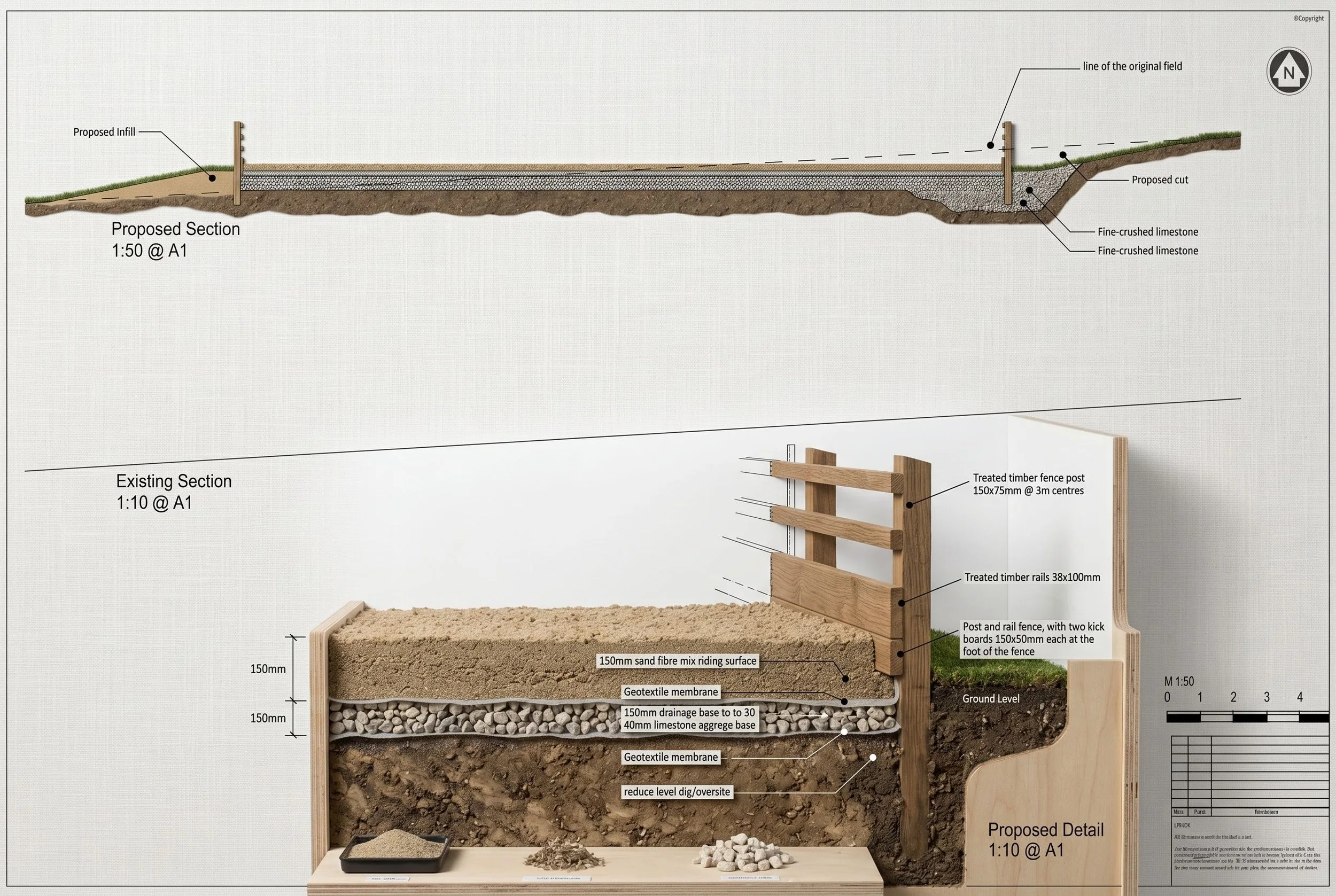
A CGI example of a strategic drainage plan - showcasing the key layers of materials.